
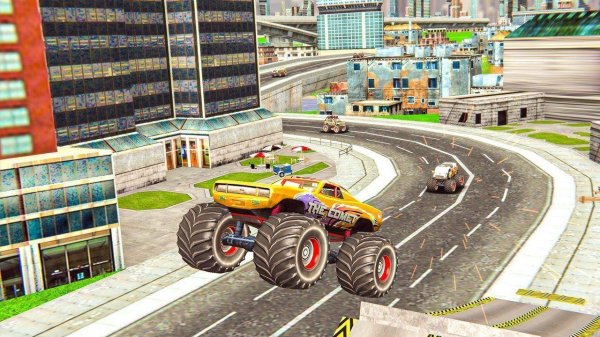
Vehicle Selection and Feel
Before hitting the road, players choose from a lineup of large trucks. Each vehicle has its own visual style and weight distribution. The driving physics emphasize mass and traction, so turning at speed or climbing a steep slope requires careful throttle control. This makes every truck feel distinct and grounded, not like a lightweight kart.
Two Distinct Course Types
The game presents two main environments. Stunt courses feature ramps, loops, and elevated platforms where maintaining balance is key. Off-road tracks wind through rugged mountain terrain with steep inclines and loose surfaces. Each type demands a different approach: smooth acceleration on ramps versus cautious navigation on rocky paths.
Checkpoint Progression System
Progress is tied to collecting all checkpoints placed along each course. These markers guide the player through the intended route and reward precision driving. Missing a checkpoint means restarting the level, which encourages learning the layout and improving control. Unlocking the next stage feels earned through practice.
Family-Friendly Design
There is no timer pressure, no combat, and no failure state beyond missing a checkpoint. The tone is relaxed and encouraging. Visuals are bright and non-threatening, with no depictions of damage or crashes. This makes the game accessible to young children and adults who prefer a low-stress driving experience.
Mastering the Controls
Players can steer using touch or tilt controls, depending on their device. The sensitivity can be adjusted to suit personal preference. Success comes from learning how each truck responds to inputs, especially when landing jumps or navigating tight corners. Gentle corrections work better than sharp movements.












Comments
0 comments